Historical Volatility
Definition
The Historical Volatility (HV) indicator measures the past price fluctuations of a security, helping traders understand the variability or risk associated with the asset. By quantifying how much the asset price has varied over a specific period, the HV provides insights into the market stability or potential for future price swings.
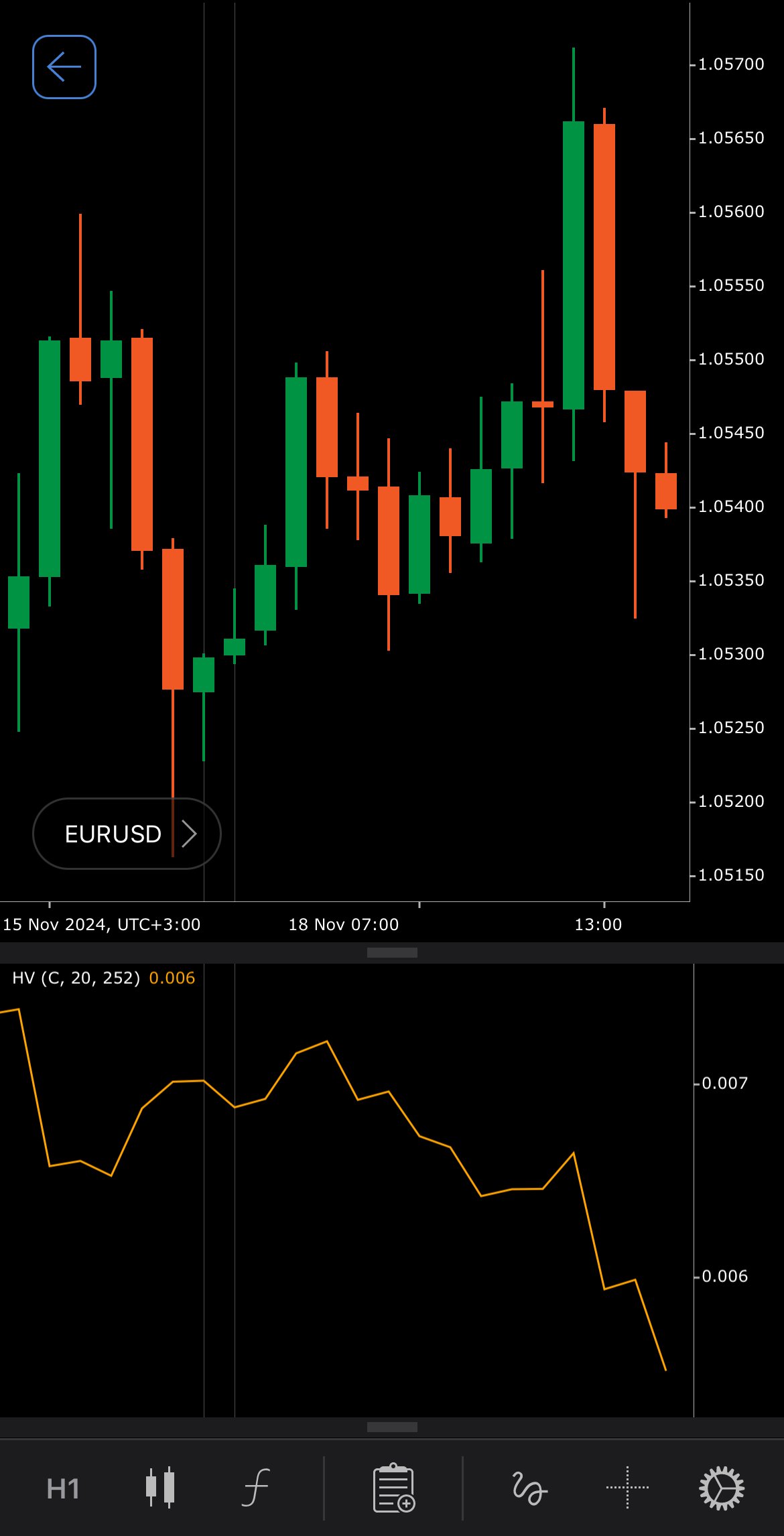
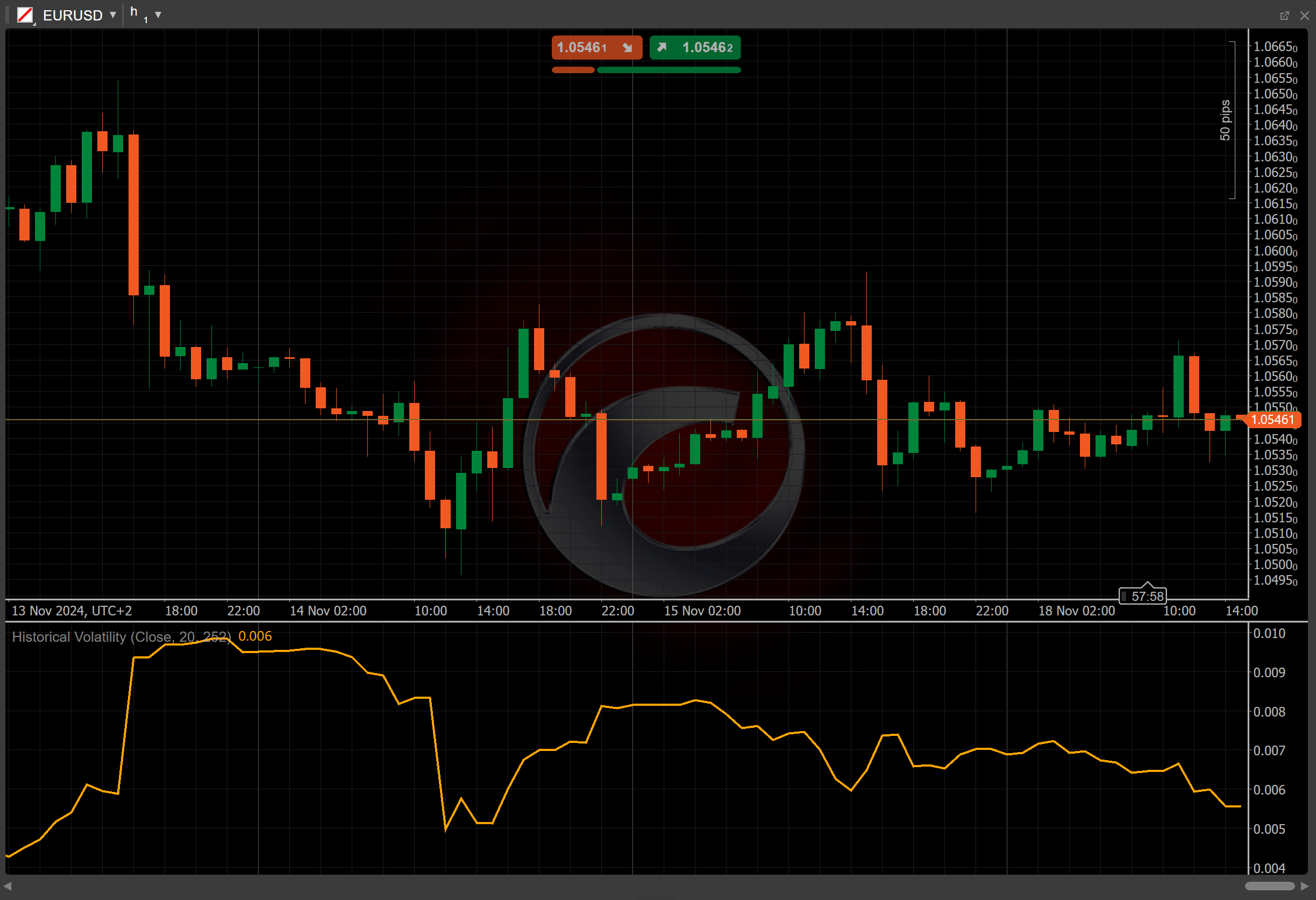
History
The Historical Volatility indicator is a standard tool in financial markets used to measure price variation over time. While the concept itself has existed for many years as a key metric for risk and volatility, it gained widespread use as traders and analysts sought to quantify market behaviour more rigorously, particularly for options pricing and risk management.
Calculations
The Historical Volatility calculation in this context relies on logarithmic price returns and standard deviation, which is a measure of price variability. The formula includes a step to annualise the volatility for a clearer long-term outlook.
1. Logarithmic returns – to calculate the volatility, the logarithmic price change between consecutive periods is used. This gives a more accurate reflection of percentage changes.
\[ Log\ (P_t) = { log_{10}\ ( { P_t \over P_{t-1} } ) } \]
2. Standard deviation – the standard deviation of the logarithmic returns is then calculated over a set period (for example, 20 days), representing the dispersion of the price changes. This standard deviation is a core component of the HV calculation and shows how much the price typically varies from the average.
\[ \sigma_{log} = { Standard\ Deviation\ ( Log\ (P_t) - Log\ (P_{t-1}), Periods ) } \]
3. Annualisation – the calculated standard deviation is then annualised by multiplying it by the square root of the bar history scaling factor, which reflects the number of trading days in a year (typically 252). This gives traders a sense of the expected yearly volatility.
\[ HV = { \sigma_{log} \times \sqrt{BarHistory} } \]
Interpretation
-
Rising – a rising HV indicates increasing market uncertainty and higher risk, signalling that prices are likely to experience larger fluctuations.
-
Falling – a falling HV suggests a more stable market with lower risk and smaller price movements.
-
Trend confirmation – the HV can be used alongside other indicators to confirm the strength of a current trend. High volatility often accompanies strong price movements in the direction of the trend.
Application
-
Buy signal – traders may look for buy opportunities when historical volatility starts to rise in anticipation of a breakout from a consolidation phase, especially when combined with bullish indicators.
-
Sell signal – a sell signal could be considered if high historical volatility is detected alongside signs of a market topping out or reversing, particularly when paired with bearish indicators.
-
Stop-loss placement – use historical volatility values to set wider stop-loss levels during periods of high volatility to avoid being prematurely stopped out and narrower levels during stable periods.
Note
You can take advantage of algo trading, with cBots executing trades based on the signals from this indicator, as shown in our examples. Learn more about how to use indicators in cBots.
Limitations
Sudden market events or shifts in sentiment can cause future price movements that are not reflected in past volatility. Additionally, the HV can be sensitive to the period used, which may result in different outcomes depending on the selected period.
Summary
The Historical Volatility calculates the past price variability of an asset by analysing its logarithmic returns over a given period and then annualising the result to provide a year-long volatility estimate. It helps traders assess risk based on historical price fluctuations, with higher HV values indicating greater volatility and risk and lower values indicating stability. HV is gaining popularity as traders and analysts seek to define values that reflect market behaviour more precisely, particularly for options pricing and risk management.